Меню
How to Combine Hair Reconstruction with Hair Coloring
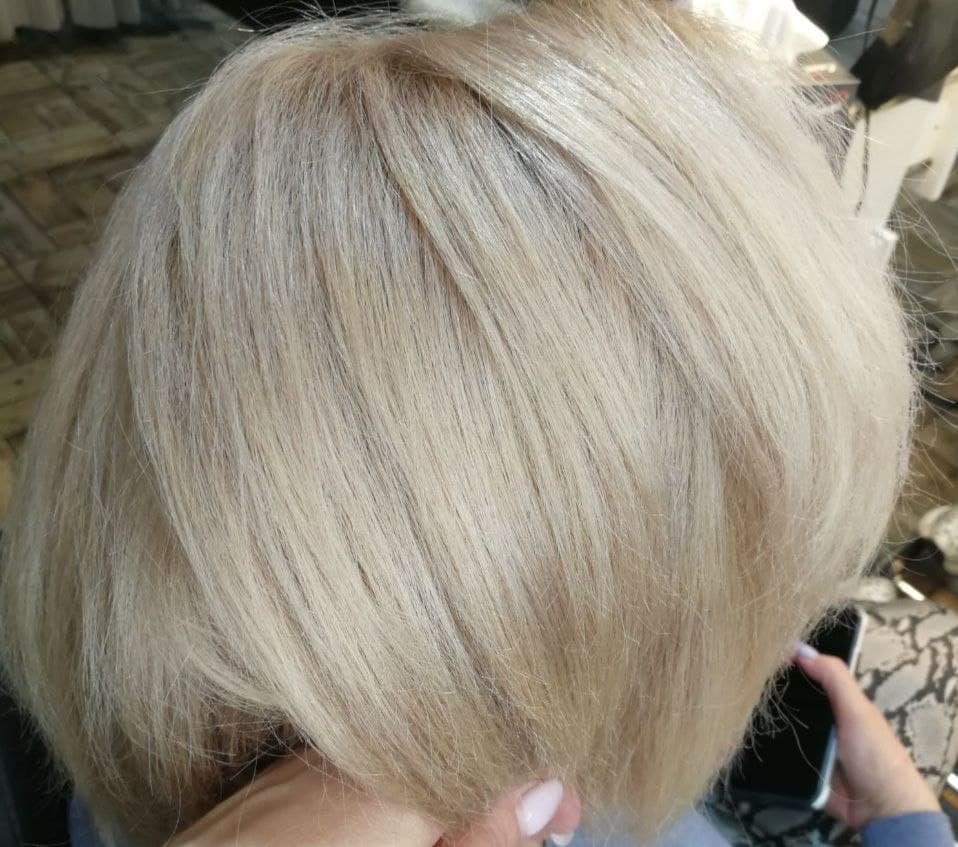
In situations like this, a reconstruction treatment can serve as an underlay for lightened hair before toning. It is necessary to fill structural gaps in the hair so that the pigment does not sink into porous areas during toning and can develop evenly.
This particular client is always lightened with powder.
Treatment steps:
1. Lighten the roots with powder to the required level of lift.
2. Remove the lightening formula using a deep-cleansing shampoo (DCS), followed by a specially selected chelating treatment containing acids. Apply it only to the lengths, emulsify, and gently remove residual pigments and accumulated chemical/mineral deposits. Leave on for up to 20 minutes.
3. Apply a keraplasty underlay:
- Vita-Cement Complex — a complex of amino acids and minerals.
- K-2 Keratin-Protein Complex — provides hydration and structural support.
- L-2 Lipid Complex — helps replenish lipids within the hair structure.
IMPORTANT — FORMULATION:
In underlays, just as in reconstruction treatments, it is important to work with molecules of different sizes.
First, a smaller molecule is applied to help penetrate deeper into the hair structure. Then a larger molecule is used to work closer to the surface and help retain the active components within the hair.
4. Process under Treatmentcare with controlled heat.
5. Rinse thoroughly with water. If shampooing is necessary, use a shampoo with a medium or low pH.
6. Apply a reconstructive mask containing silicones. This creates the necessary protective film to help preserve and retain the active components within the hair structure. Leave on for 10–15 minutes.
A NOTE FOR COLORISTS
It is always better to prevent damage at the beginning of the coloring process than to reconstruct the hair afterward.
If a full underlay is not necessary, using a protector in the color formula, appropriate bond-building products (plexes), and lipid protection on the lengths can be an important part of maintaining healthy-looking hair during chemical services.